
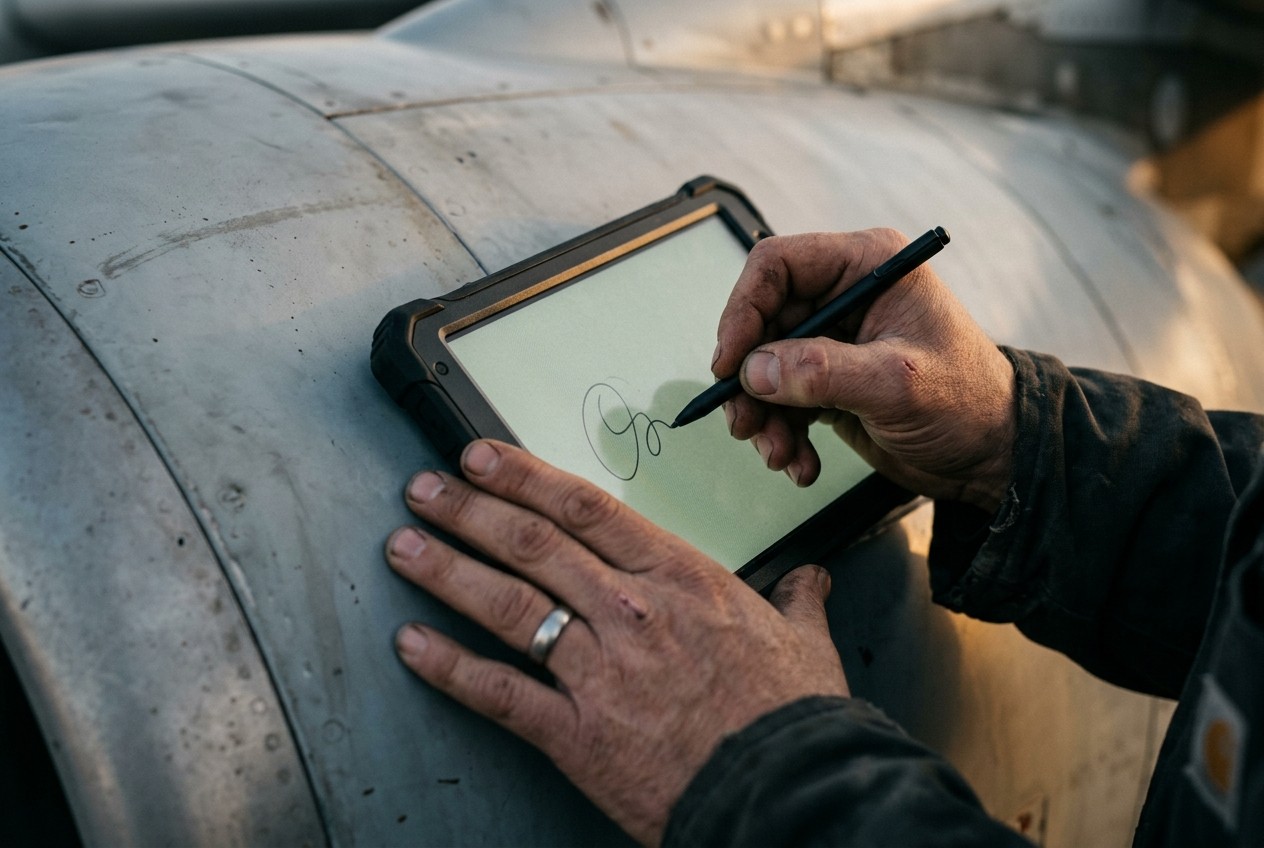

A certificate of release to service is the statement that an aircraft, or a component, is fit to return to service following maintenance. It is issued by a qualified individual acting under an approval, and it is the document that converts work performed into an aircraft that is legally allowed to fly.
Most people in an operation can describe that much. The part that gets less attention is what it commits the person signing it to, and what that means for the system capturing the signature.
It is a personal statement, not an organisational one
The approval belongs to the organisation. The certificate belongs to a person.
Whoever signs is stating, in their own name, that the work was carried out in accordance with the applicable requirements and that they are satisfied the aircraft is fit to fly. That accountability does not transfer to the maintenance organisation, to the operator, or to the software that recorded it.
Which raises an awkward question about a lot of maintenance software: if the record cannot prove who signed, under what authorisation, against which specific work, it is not capturing a release to service. It is capturing a tick.
Four things the signature has to carry
Identity. Which named individual, unambiguously.
Authorisation. Under what approval and scope they were entitled to sign. Maintenance performed by a Part 145 approved organisation carries that organisation's references, and those belong to the record too.
Scope. Precisely which work the certificate covers, with no ambiguity about what it does not cover.
Time. When it was signed, meaning when the work was actually completed rather than when the record reached a server.
That last one is where most systems quietly fail, and it connects directly to the problem described in what an electronic technical log has to do: if the entry is made at a desk hours later, the timestamp is a record of the typing, not of the work.
Why a shared login breaks the whole thing
If two people use one account, the record can no longer say which of them signed. The certificate becomes unattributable, and an unattributable release to service is not worth much when someone asks about it two years later.
Shared logins are rarely a policy decision. They are usually a response to per-seat pricing: when every additional person costs money, someone eventually decides that two engineers can share one account. The pricing model quietly produces the records problem.
This is why AirNxt does not charge per user. Seats are unlimited on every plan, and the published pricing is per aircraft, so there is never a commercial reason for two people to sign as one.
And why it has to work with no connection
A release to service is signed at the aircraft, which is frequently somewhere with no signal.
If the platform cannot complete a valid signature offline, the sign-off happens later from a note, and every one of the four requirements above degrades: the time is wrong, the scope is reconstructed from memory, and sometimes the person entering it is not the person who did the work.
Electronic CRS sign-off that completes at the aircraft, connection or not, is the only version of this that holds up.
Where it sits against the rest of the paperwork
The certificate is the output. The continuing airworthiness function decides what work was required in the first place and proves the aircraft remains airworthy between visits, which is the job carried by airworthiness management software.
For how the two halves fit together, read what MRO actually means in aviation.
Common questions
What is a certificate of release to service?
A certificate of release to service is a statement that an aircraft or component is fit to return to service following maintenance. It is issued by a qualified individual acting under an approval, and it records that the work was carried out in accordance with the applicable requirements. It is the document that converts completed maintenance into an aircraft that is legally permitted to fly, and the accountability for it attaches to the named individual who signed rather than to the organisation.
Who can sign a certificate of release to service?
Only an individual holding the appropriate qualification and acting within the scope of an approval held by the organisation. The specific entitlement depends on the regulatory framework, the category of work and the organisation's own scope, so the question of who may sign what is answered by the organisation's exposition and its approval rather than by a general rule. What is consistent is that the entitlement belongs to a named person, which is why shared accounts make a release to service unattributable.