
MRO Tracking Is an Operational Problem, Not a Software Feature

Maintenance organizations don't lose control of their operations because they lack data. They lose control because the data they have doesn't reach the people who need it, when they need it.
MRO tracking is usually framed as a software capability. It isn't. It's an operational discipline — one that software can support or undermine, but cannot replace. Organizations that treat tracking as a feature to be purchased tend to discover, after implementation, that the operations look the same.
The gap between having a tracking system and having actual visibility into your operation is wider than most organizations expect. Closing it requires understanding what MRO tracking covers, where it breaks down, and what it costs when it doesn't work.
What Does MRO Tracking Actually Cover?
MRO tracking is not task management. It is continuous visibility into the status of every work order, defect, component, and scheduled task across the fleet — at any point in time.
That scope is broader than most implementations handle. A work order system tells you where specific jobs stand. Fleet-level MRO tracking tells you what is open, what is deferred, what is overdue, and what is approaching a limit — across every aircraft, simultaneously. The distinction matters because the decisions that run an operation — scheduling, crew allocation, AOG response, maintenance planning — require fleet-level visibility, not task-level status updates.
Tracking that covers only active work orders misses deferred defects. Tracking that misses deferred defects produces an incomplete picture of aircraft status. An incomplete picture produces bad decisions. The errors that follow tend to get recorded as technical or operational events. The tracking failure behind them does not.
Where Does MRO Tracking Break Down?
Tracking fails at handoffs. Every time information moves between systems, between teams, or between organizations, there is a point where it can be delayed, incomplete, or absent.
In a typical small or mid-size operation, maintenance data moves through four or five transfers before it reaches the people who need it. The line engineer raises the defect. The planner creates the work order. The technician completes the task. The certifying engineer signs it off. The CAMO updates the continuing airworthiness record. Each of those is a transfer. Each transfer is manual. Each manual transfer is a gap.
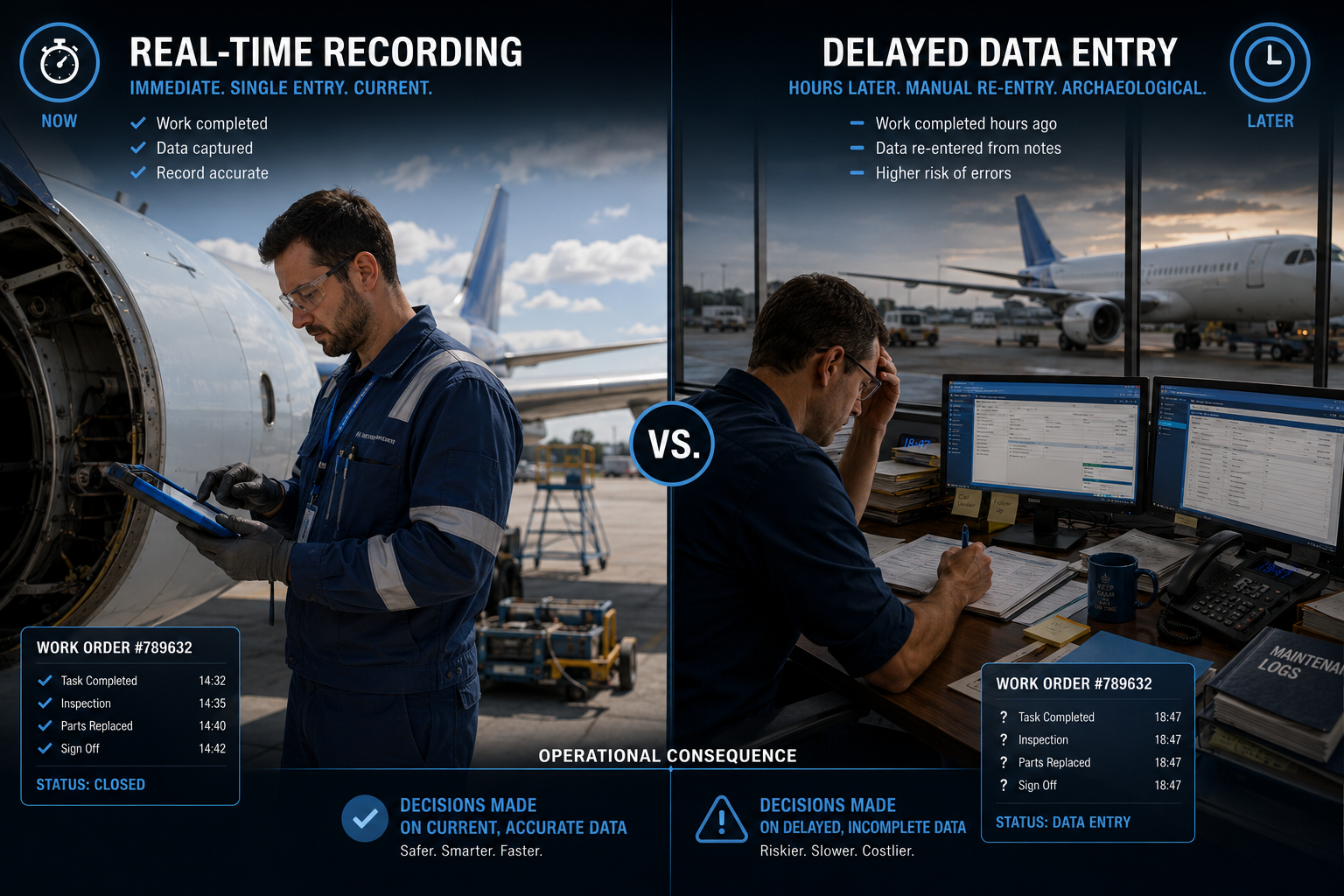
The result is that the MRO tracking system reflects the state of the paperwork, not the state of the aircraft. By the time a completed task appears in the record, the shift has moved on. By the time an open defect is visible to the CAMO, it may already have influenced scheduling decisions it shouldn't have.
There is a second failure mode that gets less attention: parallel records. When the line engineer keeps a spreadsheet, the planner uses the system, and the CAMO has its own continuing airworthiness log, there is no single source of truth. There are three. They drift apart. Reconciling them takes time that operations don't have. Decisions get made on whichever version is closest to hand.
Tracking that lags the operation by hours is not tracking. It is archaeology.
What Is the Operational Cost of Tracking Gaps?
Tracking gaps have a consistent pattern of operational consequences. They compound.
When the status of an open item is unknown, the planner defaults to the conservative assumption: the item is still open. That means scheduling decisions carry more slack than the situation requires (lost utilization). When a deferred defect isn't visible in the planning system, it doesn't appear in the maintenance forecast. Resources to address it aren't arranged in advance. AOG risk goes up.
The sequence looks like this:
- An item's status is not current in the system.
- A planner makes a scheduling decision based on stale data.
- The decision is either overly conservative (capacity loss) or insufficiently cautious (increased AOG exposure).
- The error surfaces in operations — a delayed departure, an unplanned ground stop, a shift overrun.
- The incident is recorded as a technical or operational event.
- The tracking failure that caused it is not recorded at all.
This matters because organizations that don't see the tracking failure in their data don't fix it. They absorb the cost as normal operational variance. On a fleet of 20 aircraft, tracking gaps running across multiple work orders and deferred items simultaneously can account for a meaningful share of unplanned downtime — without ever appearing as a line item in any operational report.
The cost is real. It's just invisible in the data.
What Does Real-Time MRO Tracking Require?
Real-time MRO tracking requires one condition: the record must update when the work happens, not when someone has time to enter it.
This sounds straightforward. It isn't. It requires that the people doing the work — line engineers, technicians, certifying staff — are working inside the tracking system, not running alongside it on paper and catching up later. If the system gets updated after the shift, it will always lag the operation. If it's the tool the engineer uses to raise the defect and the technician uses to sign off the task, the record updates in real time because there is no separate step.
The organizational implication is significant. Real-time tracking is not a configuration setting. It requires that the tracking system be the primary interface for the work itself — the place where defects are raised, work orders are created, tasks are signed off, and status is visible. Secondary systems that mirror paper workflows will always lag.
It also requires that the system respect the approval structure. The CAMO and the Part-145 organization have separate signing authorities — one certifies continuing airworthiness, the other certifies the maintenance work. A tracking system that collapses those into a single workflow produces a record that doesn't reflect the actual sign-off chain. That is not a minor documentation issue. It is a compliance failure.
Real-time tracking that doesn't map to the approval structure is accurate about task status and wrong about who authorized it. That combination is worse than useful.
What Changes When MRO Tracking Works?
When MRO tracking reflects the actual state of the operation, the decisions that depend on it improve — in ways that compound in the same direction as the costs of tracking gaps, but in reverse.
Scheduling tightens because the planner knows what is genuinely open, not what was open at last update. Maintenance planning becomes more accurate because deferred defects appear in the forecast before they become constraints rather than after. AOG response is faster because the status of every aircraft is available without making calls to the floor. The CAMO's continuing airworthiness picture is current because the record updates when the work is signed off, not when someone exports a file.
The operational effect accumulates. An operation with accurate, current MRO tracking makes decisions in advance because it can see what's coming. An operation without it is always reacting to what it just discovered.
That difference — anticipation versus reaction — determines throughput. It determines how many aircraft are available on schedule, how many hours are recovered from unplanned ground time, and how much of the maintenance capacity is used efficiently rather than absorbed in unplanned work and coordination overhead.
MRO tracking done right is not a reporting tool. It is the operational infrastructure that determines how well a maintenance organization runs.